Skillbuilder Projects
1) Mechanisms Project
Overview:
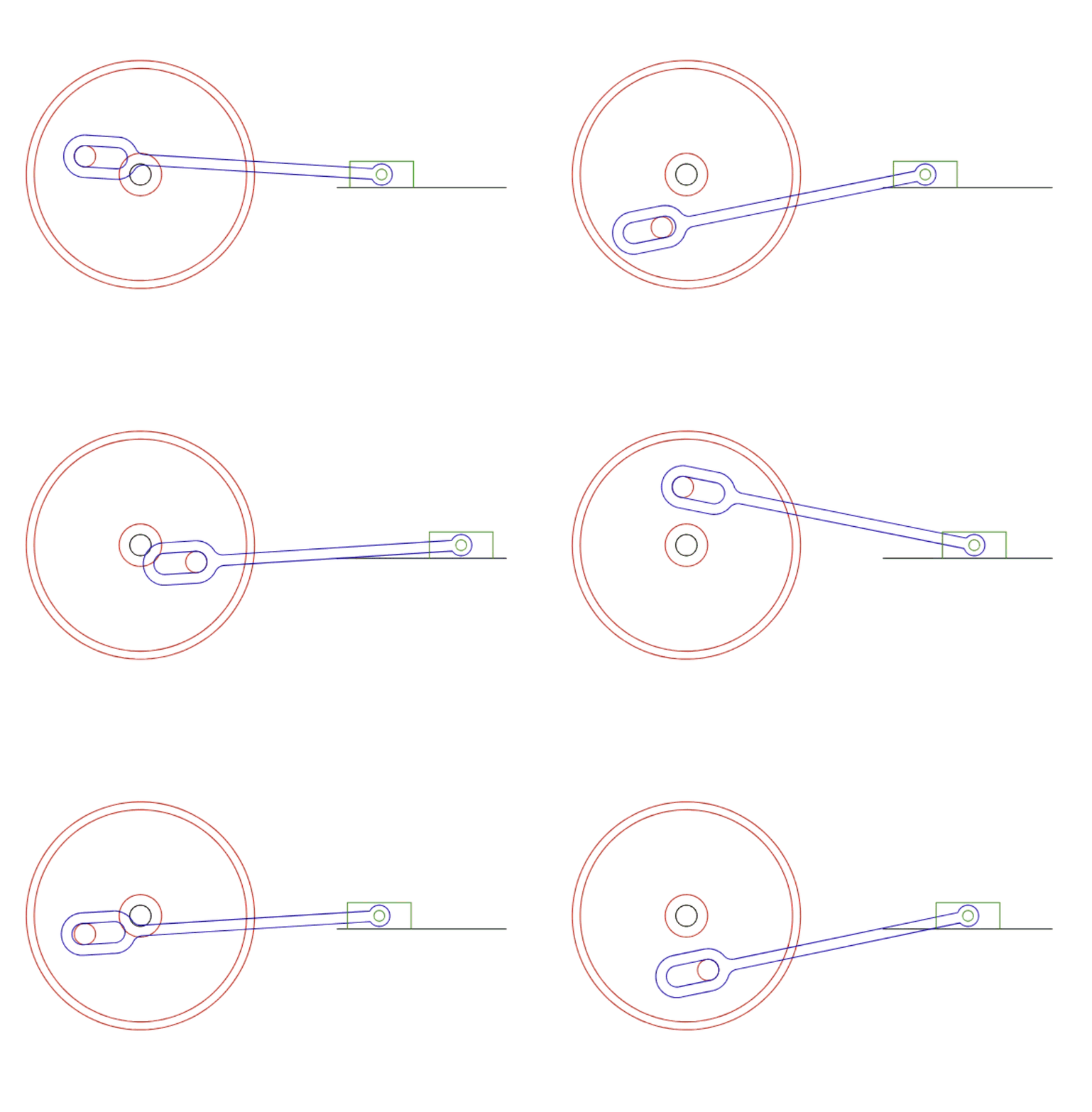
For my Mechanisms Skillbuilder, my partner and I modeled and built a mechanical system that converts rotary motion into linear motion based on Mechanism #166 (shown on the right) from 507 Mechanical Movements. Our goal was to understand and demonstrate how rotational input can generate controlled linear motion using multiple prototypes, from early hand-built models to a precise laser-cut version, while developing fabrication and CAD skills along the way.
What We Made:
Mechanism #166 converts rotary motion into linear motion. On one end, a rotating disk acts as the input. On the other, a fixed base supports a lever that generates linear movement. A connecting arm links the disk and the lever, transferring motion through a pivot joint.
Our team built three physical prototypes using different materials and fabrication methods:
-
Version 0: Notebook-paper mock-up (proof of concept)
-
Version 1 (Low-Fidelity Prototype): Cardboard model with paper and metal fasteners (functional prototype)
-
Final Version (Laser-Cut Prototype): Laser-cut model with precise dimensions and reduced friction
Each iteration improved stability, reduced friction, and refined the motion transfer between the disk and lever.
Version 0 (Paper Prototype):
The first version was made from two pieces of notebook paper and a few paper fasteners. This early model demonstrated the basic movement of the mechanism and helped us visualize how the connecting arm transferred motion between the rotating disk and lever. The material was too flexible to hold structure, but it allowed us to confirm that the concept worked.
Challenges and Observations:
-
Paper was too thin to support consistent motion
-
Fasteners worked well conceptually but lacked durability
-
Helped us confirm the geometry and proportions of the mechanism before using stronger material

Version 1 (Low-Fidelity Prototype):


The second version was built from cardboard and used both metal and paper fasteners. This gave the structure much more stiffness and made it possible to see consistent motion. However, friction between the layers caused some movement resistance.
Improvements Made:
-
Added small 1 cm × 1 cm cardboard squares between layers to reduce friction
-
Changed the connecting arm to a thinner cereal box cardboard to improve flexibility
-
Kept the same geometry as Version 0 but refined measurements for better alignment
Challenges:
-
Friction made the lever motion slightly rough
-
The material thickness made assembly less precise
Final Version (Laser-Cut Prototype):
The final version was designed in AutoCAD and laser-cut using a 16 × 12 in FYELIC template. This version matched our intended dimensions and had much smoother movement due to precise hole placement and reduced friction.
Key Design Changes:
-
Used laser-cut accuracy to improve fit between the lever and disk
-
Added low-friction tape on the fastener connecting the disk to the base
-
Adjusted the length ratio between the lever and disk for smoother motion
Technical Skills:
-
Drew all parts to scale in AutoCAD, including base, lever, connecting arm, and disk
-
Added a title block with team name, date, and project title
-
Verified geometry alignment for laser cutting


Reflection:
Through studying and building Mechanism #166, we learned the importance of sketching, planning, and iterating. We faced challenges with stability, friction, and material thickness, but found creative solutions like using layered spacers and paper fasteners to stabilize motion without a full workshop setup.
The final prototype successfully demonstrated rotary-to-linear motion and proved that the lever length should be proportional to the disk diameter for consistent motion. If we continued improving the design, we would use stronger materials like acrylic to further reduce wear over time.
This project strengthened our understanding of motion conversion, iterative design, and CAD fabrication. It also showed how small design details can make a large difference in mechanical performance.
2) Electronics Project
REQUIREMENTS FOR PORTFOLIO SUBMISSION:
Most of the content should come from the memo/presentation that you submitted for the Skillbuilder assignment. (Use memos and these requirements for chat)
-
A description of the project context (Why did you do this project? What were your goals?)
-
A description of what you made/did
-
Photos/videos/GIFS. Including:
-
Photos and/or videos of your prototypes/progress along the way
-
High quality photos and/or videos of your completed project
-
-
Demonstration of some technical skill(s) related to the skillbuilder
-
Electronics: Code/pseudocode explaining how your project works
- Ideally a flowchart or some sort of visual representation
-
-
A short story about the iterations you made and the process you followed along the way. This might include some or all of the following:
-
What you tried and didn't work
-
What you tried and worked
-
What was unique or different about your project
-
What skills you learned or demonstrated during the project
-
References to the engineering design process phases!
-
3) Take-Apart Project
REQUIREMENTS FOR PORTFOLIO SUBMISSION:
Most of the content should come from the memo/presentation that you submitted for the Skillbuilder assignment. (Use memos and these requirements for chat)
-
A description of the project context (Why did you do this project? What were your goals?)
-
A description of what you made/did
-
Photos/videos/GIFS. Including:
-
Photos and/or videos of your prototypes/progress along the way
-
High quality photos and/or videos of your completed project
-
-
Demonstration of some technical skill(s) related to the skillbuilder
-
Take-apart: design focus (problem statement, understanding engineered objects)
-
-
A short story about the iterations you made and the process you followed along the way. This might include some or all of the following:
-
What you tried and didn't work
-
What you tried and worked
-
What was unique or different about your project
-
What skills you learned or demonstrated during the project
-
References to the engineering design process phases!
-